What is it?
Localized damage to the skin and underlying tissue caused by prolonged or intense pressure, often combined with shear.
- Commonly occurs over bony prominences or beneath medical devices.
- Previously called pressure ulcers, bedsores, or decubitus ulcers.
Why does it matter?
- Sustained pressure can impair local blood flow and damage tissue.
- Injuries may progress into deeper structures and increase infection risk.
- Prevention requires pressure redistribution, skin care, nutrition, and mobility support.
What should I look for?
Pressure Injury Stages
| Stage | Characteristics |
|---|---|
| Stage 1 | Intact skin with persistent, nonblanchable redness or localized color change. May also have temperature, firmness, or sensation changes. |
| Stage 2 | Partial-thickness skin loss exposing the dermis. Pink/red moist wound bed or a serum-filled blister. No visible fat, slough, or eschar. |
| Stage 3 | Full-thickness skin loss; subcutaneous fat may be visible. Tunneling, undermining, or slough may occur. No exposed muscle, tendon, or bone. |
| Stage 4 | Full-thickness skin and tissue loss with exposed or directly palpable deeper structures such as fascia, muscle, tendon, or bone. |
| Unstageable | Full-thickness injury where slough or eschar obscures the extent of tissue loss. |
| Deep Tissue Pressure Injury | Persistent deep red, maroon, or purple discoloration, or a blood-filled blister suggesting underlying tissue damage. |
Blanching
- Blanchable: Redness temporarily lightens when pressure is applied.
- Nonblanchable: Redness persists despite pressure being applied.
- Darker skin may show changes in color, warmth, firmness, or sensation rather than obvious redness.
Common Locations
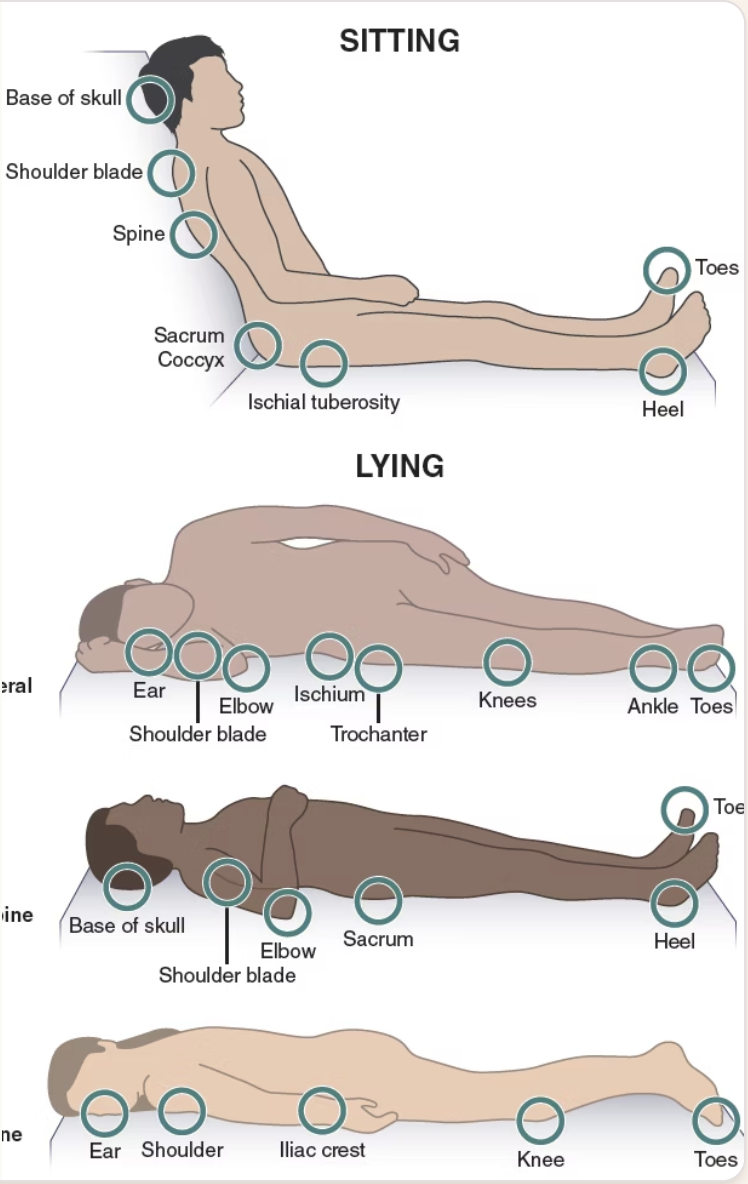
- Sacrum and coccyx.
- Heels and ankles.
- Hips and sitting bones.
- Elbows and shoulder blades.
- Back of head and ears.
- Areas beneath medical devices.
Risk Factors
- Immobility or prolonged pressure.
- Friction and shear.
- Incontinence and excessive moisture.
- Reduced sensation or consciousness.
- Poor nutrition or hydration.
- Fragile skin or poor circulation.
- Increased local heat and humidity (microclimate).
What should I do?
- Observe skin during routine care, especially pressure points.
- Report new redness, discoloration, blisters, open areas, or pain promptly.
- Follow individualized repositioning and pressure-relief schedules.
- Use prescribed pillows, support surfaces, and offloading devices.
- Keep skin appropriately clean and dry.
- Minimize friction and shear during transfers and repositioning.
- Encourage mobility and adequate nutrition within the care plan.
- Avoid massaging reddened pressure areas.
- Follow nursing instructions for skin products and wound protection.
CNA Scope: Observe and report skin changes. Formal pressure injury staging and wound treatment are performed by appropriately qualified clinical staff.
Related
- Skin Integrity & Breakdown Prevention
- Repositioning in Bed
- Patient Positions
- Limited Mobility
- Skin Findings & Terminology
- Integumentary System
Sources
- CNA Module 8 — Patient Care Skills
- NPIAP — Pressure Injury Stages
- AHRQ — Pressure Injury Staging
Flashcards
What characterizes a stage 1 pressure injury?01-foundations / diseases-conditions
Answer
Intact skin with nonblanchable erythema or a comparable change in darker skin.
What is an unstageable pressure injury?01-foundations / diseases-conditions
Answer
Depth is obscured by slough or eschar.
Who determines pressure-injury staging?03-application / diseases-conditions
Answer
Qualified licensed clinicians, not CNAs independently.